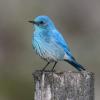
Over 20 species of hummingbird possible on this tour, including the stunning Sparkling Violetear. Pomacochas 2009. Chris Charlesworth.
Peru, with around 1,800 species of birds on its list, is one of the planets birdwatching gems. With over 300 species endemic to Peru, this is a must visit country for birders! We will visit the eastern slope of the Andes in Northern Peru on this tour.
Our adventure will begin in the mountain city of Cajamarca, where beautiful architecture, culture and history are of special note. From Cajamarca we’ll explore rocky canyons where endemic hummingbirds like the Gray-bellied Comet and the Black Metaltail can be found.
The drive from Cajamarca to Celendin is an exciting experience. The road winds through rocky mountain passes, taking us high up into the clouds in the paramo grasslands where we may find Paramo Pipit, White-tailed Shrike-Tyrant, and perhaps Andean Condor!
From the bustling town of Celendin we make our way towards the Maranon River Valley, a beautiful and arid place, where endemic birds abound. A few of these birds include Maranon Thrush, Chestnut-backed Thornbird and the Buff-bridled Inca-Finch.
The vistas as we descend into and then climb back out of the Maranon Valley are some of the best views on earth! Patches of mountain evergreen forest we encounter enroute to Leimeibamba, should have the endemic Russet-mantled Softail, as well as other goodies like Blue-and-Black Tanager, Superciliaried Hemispinghus, or the beautiful Shining Sunbeam.
The quaint town of Leimeibamba is a joy to visit. Birding gardens not far from our accommodations we’ll search for the endemic Marvelous Spatuletail, the most outrageous hummingbird on earth! We’ll have to pull ourselves away from the spatuletail in order to view other birds here like Sword-billed Hummingbird, Green-tailed Trainbearer and Black-throated Flowerpiercer.
At Pomocochas, where we stay for a night, we’re near a beautiful lake where grebes, herons, ducks and more can be seen.
Two nights at the world-renowned Abra Patricia Lodge will be a highlight for us. This area is well known for its abundance of birds including endemics like Johnson’s Tody-Tyrant, and the rare and little known Long-whiskered Owlet. With luck we’ll see monkeys in the area, most likely Brown Capuchins. The primary evergreen forest here is spectacular, overflowing with towering trees, clumps of beautiful bromeliads and pristine creeks. On these creeks we could see Torrent Ducks and perhaps White-throated Dipper. Flocks of stunning tanagers move through the trees, and provide a feast of color for the eyes.

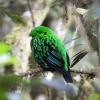
One of the most bizarre looking birds on earth. Abra Patricia area, 2009.
Chris Charlesworth
Once we depart the Abra Patricia area and make our way towards Rioja and the lowlands, our bird list will grow fatter with the addition of many birds. The list of highlights from the area is too long to mention but includes such stars as Thrush-like Wren, Oriole Blackbird, Cobalt-winged Parrotlet and Russet-crowned Crake!
As we make our way down towards Tarapoto and the lowland jungles the temperatures will rise as will the humidity. Again lots of birds await to be discovered in this area. Our accommodations are fantastic in Tarapoto, with Black-fronted Nunbirds, Yellow-tufted Woodpeckers and Lesser Kiskadees right on site!
This will be a tour you don’t want to miss out on.
Day 1 Travel from Toronto to Lima.
Day 2 Birding in the Lima area. Night in Lima.
Day 3 Early morning flight from Lima to Cajamarca, high in the Andes. We begin by making our way into nearby canyons where a number of rare hummingbirds can be found. The endemic Gray-bellied Comet and Black Metaltail inhabit the dry valleys along Rio Chonta. Also in this area are stunning Giant Hummingbirds as well as dazzling Andean Hillstars. Chiguanco and Great thrushes will be seen in open areas. Cute little Torrent Tyrannulets forage along the creek bed, as do White-winged Cinclodes. Overhead the sky will be alive with Andean Swifts, Brown-bellied Swallows and Blue-and-white Swallows. In the creek-side shrubbery we should find Rusty-crowned Tit-Spinetail, Blue-and-yellow Tanagers, Rufous-naped Brushfinch, Peruvian Sierra-Finch and several other species. Black-chested Buzzard-Eagles often sail overhead. Later on in the afternoon we'll make our way to San Marcos, an area good for the endemic Great Spinetail. Night in Cajamarca.
Day 4 Today we'll make our way from Cajamarca to Celendin. We'll travel through some stunning scenery, climbing high mountain passes. The people of this region of Peru are well-known for their hats and colourful clothing. Birding will be excellent! We'll watch the skies for beautiful Mountain Caracaras. Wooded areas should have Andean Flickers and Rusty Antpittas. Open areas will be scanned for White-tailed Shrike-Tyrants, which are rarer than their cousin, the Black-billed Shrike-Tyrant. In open areas of high elevation grassland we'll search for Paramo Pipits. With a little luck maybe we'll spot an Andean Goose! In the late afternoon we'll carry on to Celendin where we spend the night.
Day 5 With some of the best birding on the whole tour, today should be a very memorable day of birding. We'll make our way from Celendin, down many thousand feet into the bottom of the dry, desert Maranon River Valley. We'll start off at El Limon, a good site for Gray-winged Inca-Finch. Also in the El Limon area are Jelski's Chat-Tyrant, Rufous-breasted Warbling-Finch, and with luck a Fawn-breasted Tanager. Along the way we'll encounter many birds, of which numerous are endemic. Gorgeous Peruvian Meadowlarks, with their deep red breasts sing from roadside fence posts. As we descend into the Maranon Valley we'll begin to see Long -tailed Mockingbirds, Bare-faced Ground-Dove, Yellow-tailed Oriole, and the endemic Maranon Thrush. Spot-throated Hummingbird, another Peruvian endemic, can be found here at El Limon. The Chestnut-backed Thornbird is a great bird to watch at its large bulky nests, and again is an endemic species. Dry desert hillsides are home to the endemic Yellow-faced Parrotlet, as well as Buff-bridled Inca-Finches. With luck we'll find the Maranon subspecies of Tropical Gnatcatcher, a possible full species split. We hope to see the Black-necked Woodpecker, an endemic of this part of N. Peru. Rare and local Peruvian Pigeons are often seen zipping up and down the river. Peruvian Pygmy-Owl can be found in this dry valley. Each day we'll keep our eyes peeled for Andean Condor soaring overhead. We'll have a long drive in the afternoon as we make our way to Leymebamba. Enroute, we'll hope for a mixed flock of birds moving through the cloud forest. On a previous trip we had Superciliaried Hemisphingus, Buff-bellied Mountain-Tanager, Blue-and-black Tanager, Rufous-browed Peppershrike, Streaked Tuftedcheek, and the endemic Russet-mantled Softail. Night in Leymebamba.
Day 6 After breakfast we'll make our way to the town of Pedro Ruiz, where we'll search for the Little Woodstar. The road follows the Utcabamba River where Fasciated-Tiger Herons, Torrent Ducks, and Green Jays are often found. We'll visit La Florida where we'll search for the magnificent and endemic Marvelous Spatuletail. Feeders in the area should also have treats such as the stunning Sword-billed Hummingbird, Sparkling Violetear, Long-taild Sylph, Purple-collared Woodstar, Emerald-bellied Puffleg and White-bellied Hummingbird. Golden-bellied Grosbeaks, Buff-bellied Tanagers (endemic), Black-throated Flowerpiercers, Hooded Siskins and more also inhabits these grounds. As we make our way towards Pomacochas we'll make a couple of stops for Plain-breasted Wren, Speckle-breasted Wren, Green-throated Tanager and Blue-browed Tanager to name a few. We'll pass by Lake Pomacochas on our way to Abra Patricia, where we are fortunate enough to stay for 3 nights at the Owlet Lodge.
Day 7 For the next couple of days we can bird the Abra Patricia area, famous for birding. The mountains surrounding the lodge are cloaked in evergreen forest are filled with avian wonders such as Pale-billed Antpitta, Johnson's Tody-Tyrant and Rufescent Screech-Owl. A myriad of bright and colourful tanagers will be found in this area, including Magpie Tanager, Rufous-crested Tanager, Grass-green Tanager, Flame-faced Tanager, Golden Tanager, Beryl-spangled Tanager, Saffron-crowned Tanager, Paradise Tanager and the uncommon White-capped Tanager. Tonight and tomorrow night we'll stay at the renowned Abra Patricia Lodge, otherwise known as the Owlet Lodge because of recent sightings of one of the world's rarest owls, the Long-whiskered Owlet!
Day 8 The entire day will be devoted to birding the Abra Patricia area. We'll head off to the Beautiful Valley (Valle Hermoso) after breakfast. The extremely rare and local Long-whiskered Owlet can be found in this area. In lush ravines we'll search for the rare and beautiful Royal Sunangel. Overhead, big and graceful White-collared Swifts should be seen, alongside smaller species such as White-tipped Swift. Beautiful Cliff Flycatchers dart out from sheer rock faces after insects. The gorgeous song of the Andean Solitaire as well as Glossy-black Thrushes will echo from the primary forest. Emerald Toucanet can be found foraging in amongst giant bromeliads. Later on in the afternoon once we return to Abra Patricia Lodge we can do a little birding on the lodge grounds. Hummingbird feeders here attract many species including Emerald-bellied Puffleg, Collared Inca, Bronzy Inca, Fawn-breasted Brilliant, Speckled Hummingbird, Green-tailed Trainbearer and perhaps Chestnut-breasted Coronet. Night at Abra Patricia Lodge.
Day 9 For the second day, we'll explore the Abra Patricia area, especially the Afluente area. In this area we will look for Speckle-chested Piculet, Equatorial Gray-tail, Marble-faced Bristled-Tyrant, Violet-headed Hummingbird, Ecuadorian Piedtail and other tantalizing birds. Our hopes are high today for the sought-after and very bizarre Andean Cock-of-the-Rock. Flocks of parrots are often encountered in these beautiful cloud forests, including Military Macaw, Mitred Parakeet and Blue-headed Parrot. Brown Capuchin monkeys can be found moving through the trees in small parties in the Abra Patricia region. In the late afternoon we'll make our way to the small town of Rioja, where we spend the night.
Day 10 Our explorations will center at the Rioja and Aguas Verdes areas today. This area of lower elevation forest will provide an exciting list of new species for our list as we descend the eastern slope of the Andes, such as Buckley's Forest-Falcon, Napo Sabrewing, Plain-backed Antpitta, Foothill Antwren and the attractive Versicolored Barbet. Dark-mandibled Toucans yelp to each other from snags protruding above the canopy. The forest here is lush and green! Brilliantly colored birds like Ornate Flycatcher, Swallow Tanager and Yellow-tufted Woodpecker stand out amongst the forest greenery. We'll spend the night in Rioja.
Day 11 Today we'll visit the Yacumama and Calzada areas where open areas of savannah provide habitat for some new and interesting birds. Not far from Rioja we'll encounter a good savannah habitat for Tataupa Tinamou, Plain-breasted Ground-Dove, and Wedge-tailed Grass-Finch. Other nearby habitat types holds the Russet-crowned Crake, Olive-chested Flycatcher, Burnished-buff Tanager, Point-tailed Palmcreeper and Cobalt-winged Parakeets. There is another savannah habitat in the Calzada area that includes the Blackish Rail, Cream-colored Woodpecker, Cinereous-breasted Spinetail, Yellow Tyrannulet, Lesser Seed-Finch and Pale-eyed Blackbird. The forest at Morro de Calzada can produce the Lafresnaye's Piculet, Mishana Tyrannulet, Fiery-capped Manakin, Striped Manakin, Pale-breasted Thrush and Blue-crowned Trogon. In the late afternoon we'll drive to the low elevation jungle town of Tarapoto, where we'll overnight.
Day 12 An early departure is required to make our way to Juan Guerra. Here, we'll search for Chestnut-capped Puffbird, Stripe-chested Antwren and the Maranon Slaty Antshrike. With a little luck we'll see a Three-toed Sloth! Later in the day we'll head for Quebrada Upaquihua for the Planalto Hermit, Mishana Tyrannulet and the Ashy-headed Greenlet. We'll spend the night in Tarapoto. Around town, if we get a chance to explore green areas, there should be Black-fronted Nunbird, Lesser Kiskadee, Vermilion Flycatcher and the ever present Rufous-collared Sparrow. Night in Tarapoto.
Day 13 We explore the El Tunel area this morning. The region has a nice lower elevation mountain evergreen forest that offers opportunities to see Dotted Tanagers, Blackish Pewee, Koepke's Hermit, and the beautiful Purple Euphonia. Night in Tarapoto.
Day 14 This morning we may do a bit of birding around Tarapoto if time permits. For those who are joining the Amazon Extension, we'll fly to Iquitos in the heart of the jungle today. Others will fly back to Lima.
AMAZON EXTENSION – November 1 – 6
Day 1 Once we arrive in Iquitos we'll make our way down to the Explorama Docks where we'll board a riverboat and take a 1.5 hour journey to Explorama Lodge. From the docks we may see Large-billed Terns, Lesser Yellow-headed Vultures, Cobalt-winged Parakeets and much more. As we make our way along the river we'll keep our eyes open other birds and animals. Once we arrive at Explorama Lodge we'll have do some exploring for Thrush-like Wren, Silvered Antbird, Pale-legged Hornero and with luck both Scarlet and Blue and gold macaws. Spectacular Sun Bitterns are often seen lurking in the shadows around the lodge. Night at Explorama Lodge, situated along Yanamono Stream. During our stay at Explorama Lodges there are several guided tours you may wish to take instead of a particular stretch of birding. In addition to birding walks, there are botany, culture and other programs available.
Day 2 This morning we'll do some more birding near Explorama Lodge, walking trails where we'll search for such tantalizing birds as the Golden-headed Manakin, Black-collared Hawk, Capped Heron and 3 different species of kingfisher! We then have breakfast back at the lodge and load up into the riverboat for an 80 km journey to the ExplorNapo Lodge on the Napo River. En route, with a little luck, we'll see both pink and gray freshwater river dolphins! Once we arrive at Explornapo Lodge we'll get settled before exploring the jungles for species like Nocturnal Currasow and the rare Black-necked Red Cotinga. Night at ExplorNapo Lodge.
Day 3 Today we'll visit the canopy walkway, spanning 500 meters above the jungle at a height of up to 35 meters. Here we'll experience the canopy life, a part of the jungle rarely seen. A wide variety of birds can be seen at eye level here. Amongst the long list of birds possible here are Rufous Motmot, Channel-billed Toucan, Lemon-throated Barbet and Red-throated Caracara. During our stay at Explorama and ExplorNapo lodges we'll see some interesting mammals as well, including Three-toed Sloth. Primates we may see include Red Titi Monkey, Saddle-backed Tamarin, Squirrel Monkey, the bizarre Monk Saki, Pygmy Saki and noisy Howler Monkey. Night at ExplorNapo Lodge.
Day 4 Birding around ExplorNapo Lodge before boat ride back to Explorama Lodge. Night at Explorama Lodge.
Day 5 Early morning birding at Explorama before boat ride back to Iquitos and flight to Lima. Night in Lima.
Day 6 Day of birding in the Lima area. Night in Lima.
![]()
to us with any questions or comments about this website.
Copyright © Avocet Tours 2002-2012. All Rights Reserved.
Website development by Cool New Media