Day 0 – Oct 14: Arrive in Sorong, no planned birding though depending on arrival time we may choose to arrange some additional birding (not included in tour cost). Night in Hotel in Sorong.
Day 1 – Oct. 15: Early departure to Malagufuk. We may opt to do some birding along the road to this small eco-village. Twelve-wired Bird-of-Paradise, Eastern Hooded Pitta, Black Lory and Golden Myna are possible, and we should encounter a variety of fruit-doves as well as our first taste of various other common lowland species. We will walk in, on the 3.5km boardwalk, to Malagufuk for lunch. Birding along the boardwalk can be excellent and we will aim to start picking away at the long list of incredible specialties that occur here. These include Northern Cassowary, Red-billed Brushturkey, New Guinea Bronzewing, Pheasant Pigeon, Forest Bittern, Papuan Frogmouth (often roosting or nesting along the way), Papuan Pitta, Red-breasted Paradise-Kingfisher, Blue-black Kingfisher, Papuan Dwarf-Kingfisher, White-eared Catbird and Blue Jewel-Babbler. Over the course of our two days birding here, we will aim to pick off as many of these as we can. Many other commoner species will be on offer as well and these include various pigeons and parrots, Frilled and Golden monarchs, Golden Cuckooshrike, Yellow-breasted Boatbill, Emperor Fairywren, Black-sided Robin, Rufous-bellied Kookaburra and Blyth’s Hornbill.
After lunch we will bird the trails around the village.
Night in basic cabins in the small village of Malagufuk.
Day 2 – Oct. 16: Our full of day of birding will start with a pre-dawn departure to get to the display site of either Twelve-wired BOP (if we didn’t see it the day before) or the Lesser BOP lek. We will also aim for display sites of Magnificent Riflebird and the stunning little gem that is the King BOP that favor mid-canopy vines as their dancefloor. With any luck there will be a known fruiting tree under which a Northern Cassowary is frequenting. Weather permitting, we will spend a full morning birding the trails and continue to do so after lunch and a short siesta. Either the night before, or this evening (or both) we will have the opportunity to do some night birding for Papuan and Marbled frogmouth, Papuan Nightjar, Papuan Boobook and Rufous Owl. These outings can be good for roosting birds as well and may be our best chance at the scarce Thick-billed Ground-Pigeon while pittas and Papuan Dwarf-Kingfisher are also regularly spotlighted. If we are lucky we may spotlight some other animals such as Couscous, New Guinea Glider and if we are willing to put in a couple hours to get to the site and back, the bizarre Long-beaked Echidna.
Night in basic cabins in the small village of Malagufuk.
Day 3 – Oct. 17: After breakfast we will bird our way slowly out along the boardwalk, targeting whatever we have yet to see. In the afternoon we will do some birding, possibly around Sorong (likely visiting the Mangroves) or to a site near to Malagufuk which has held an active nest of the rare Forest Bittern in recent years.
Night in Hotel in Sorong
Day 4 – Oct. 18: If we have time in the morning we will do some birding around the mangroves near Sorong. Little Kingfisher and Blue-black Kingfisher are possible as well as Orange-fronted Fruit-dove and Brown-backed Honeyeater among others.
The fast ferry from Sorong to Waigeo is usually not very birdy but on occasion flocks of Streaked Shearwater can be seen along with Lesser Frigatebird, Bulwer’s Petrel and a few species of terns. If we are particularly fortunate, we may come across the rare Matsudaira’s Storm-Petrel. Short-finned Pilot Whales are frequently seen from the ferry as well.
Once on Waigeo, we will spend the rest of the afternoon with some easy birding looking for Beach Kingfisher, Rufous-bellied Kookaburra, Great-billed Parrot, Hooded Butcherbird, Glossy-mantled Manucode, Coconut Lorikeet, Singing Starling and more.
On our evenings we will have the opportunity to do some owling if we missed any of Wallace’s Owlet-Nightjar, Papuan Frogmouth or Papuan Boobook at Malagufuk and we may encounter the striking Waigeo Spotted Couscous (a marsupial).
Night at Dive Resort or similar.
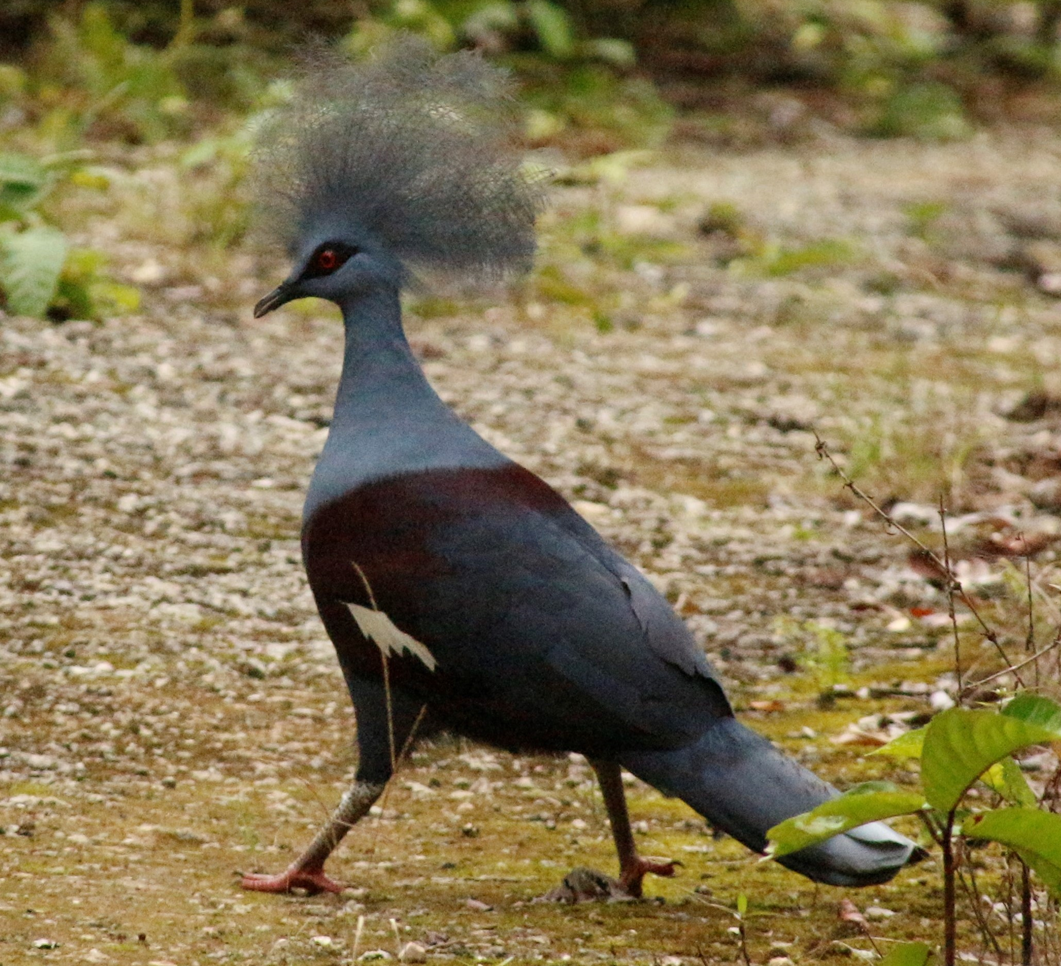
Day 5 – Oct. 19: We will have an early, pre-dawn start to get to the Wilson’s Bird-of-Paradise hide in time for first light. This is perhaps the most spectacular of this gaudy group of birds and if we don’t obtain good views of a displaying male on its ground level display arena this morning, we can try a second hide the following day. In the forest and at the hide we may also run into species like Rusty Mouse-Warbler, Mimic Honeyeater, Waigeo Shrikethrush, Raja Ampat Pitohui, Hook-billed and Yellow-billed kingfishers and more. Waigeo is also a good backup spot for the majestic Western Crowned-Pigeon which we will have tried for in Malagufuk earlier.
In the afternoon we will target another stunning BOP, the Red Bird-of-Paradise. Unlike the Wilson’s, this species displays in leks in the canopy and sub-canopy and these can often be active later in the day.
Night at Dive Resort or similar.
Day 6 – Oct. 20: This morning’s activities will depend somewhat on how the previous day went. Assuming we got satisfactory views of the two BOPs the previous day we will do some general birding around the forested areas looking for species like Dusky Megapode, Moluccan King Parrot, Palm Cockatoo, Black-capped Lory, Brown-headed Crow, Claret-breasted Fruit-Dove, Spice Imperial-Pigeon and more.
In the afternoon we will plan to take a boat ride out to some offshore islets to find a few small-island specialties such as Violet-necked Lory, Island Whistler, Moluccan Starling and Supertramp Fantail. We may also have an opportunity to do some snorkelling for those who wish to do so.
Night at Dive Resort or similar.
Day 7 – Oct. 21: After a last morning of birding on Waigeo we will ferry back to Sorong. Time permitting, we will do some birding near the city.
Day 8 – Oct. 22: After flying east to Manokwari, we will transfer up into the famous Arfak Mountains where several more BOPs and a host of endemics that we won’t see elsewhere await. After a first week in the hot and humid lowlands, the cool temperatures will be a welcome reprieve.
En route, we may make one or two birding stops to break up the ~2hr journey. In the late afternoon we will have some time to bird around the vicinity of our lodgings and become acquainted with some of the commoner middle elevation species. We may also decide to visit one of the bird hides and/or a roost site for one of three species of Owlet-Nightjar (Mountain, Feline and the rare Vogelkop) that can often be found in the area.
Night at basic homestay/lodge in Arfak Mountains.
Days 9-12 - Oct. 23-26: We will have 5 nights in the Arfak Mountains and over the course of these days we will spend time at hides for several spectacular species. BOPs like Magnificent Bird-of-Paradise, Vogelkop Lophorina, Western Parotia plus Vogelkop Bowerbird all have their own hides and there are additional ones that have pandanus fruit put out at them which attracts the aforementioned BOPs, Black Sicklebill and Black-billed Sicklebill and several other species such as Arfak Catbird, Lesser Ground-Robin, Ashy Robin and more. There may also be an active hide for the rare Wattled Brushturkey.
In addition to the hides, there is a list as long as one’s arm of special birds that we will be looking for in the forest during our time here. White-striped Forest-Rail, Papuan Logrunner and Lesser Melampitta skulk along the forest floor, while we will hope to find as many as possible of the following: Rufous-throated Bronze-Cuckoo, (Western) Ornate Fruit-Dove, Red-breasted Pygmy-Parrot, Brehm’s and Modest Tiger-Parrots, West Papuan Lorikeet, Masked Bowerbird, Papuan Treecreeper, Elfin Myzomela, Vogelkop and Ornate Melidectes, Arfak Honeyeater, Goldenface, Tit Berrypecker, Spotted and Chestnut-backed Jewel-Babblers, Black-breasted Boatbill, Mountain Peltops, Mottled Berryhunter, Vogelkop Whistler, Hooded Pitohui, Black-winged Monarch, Smoky and White-rumped robins alongside many others.
We may also have an opportunity to spend a night at the higher elevations of German Camp if anyone feels up to the hike and the very rustic cabin. The two main attractions up here are seeing the incredible display of the Black Sicklebill in the early morning and one of the more difficult BOPS, the Arfak Astrapia (this is missed more often than seen). A few other higher elevation species can be found up here that are trickier around the main birding sites. If we don’t spend a night at German Camp, we will at least walk some portion of the trail as there is a feeding station partway up that is good for another special BOP, the Long-tailed Paradigalla.
Lastly, on one of our days, we may decide to drive to a highland site for the Grey-banded Munia which is endemic to high elevation grasslands in the Arfak Mountains. Here we can also add Papuan Grassbird.
Nights at basic homestay/lodge in Arfak Mountains.
Day 13 – Oct. 27: After a final morning birding the Arfak Mountains, we will drive down to Manokwari for a much-anticipated night in a nice hotel with a hot shower!
Night in a good Hotel in Manokwari
Day 14 – Oct. 28: This will be a travel day starting with a flight to Jayapur/Sentani. From the airport, we will transfer ~2hrs to the small community of Nimbokrang where we will spend the night in a basic lodge.
We will bird for however long we have in the afternoon. Mostly, this will be to target any lowland species we didn’t get around Sorong or on Waigeo though there are a few species that this will be our only time in range for. We will keep an eye out for Dwarf Koel, Buff-fronted Pygmy-Parrot, Ochre-collared Monarch and Common Paradise Kingfisher.
Weather permitting, we may feel like doing a bit of night-birding for species like Papuan Nightjar, Marbled Frogmouth and Papuan Owl.
Night in basic lodge/homestay in Nimbokrang
Day 15 – Oct. 29: For our one full morning of birding at Nimbokrang we will focus on the Pale-billed Sicklebill and, if we haven’t already got good looks elsewhere, Twelve-wired BOP. If we are very lucky, we may also encounter the rare Shovel-billed Kookaburra though this species is seemingly much more difficult here than it once was. Other nice birds we may come across include the rare Red-legged Brushturkey, Salvadori’s Fig-Parrot, Jobi Manucode, Brown Lory and a few species of Fantails.
In the afternoon we will either bird some more around here or return to Jayapur and bird a bit at a grassland site where Grand and Hooded munias occur along with Brown Quail, Golden-headed Cisticola, White-shouldered Fairywren and perhaps Cinnamon Bittern.
Night in good hotel in Jayapur.
Day 16 – Oct. 30: If there is time before our flight we will do a little birding around Jayapur. Otherwise, we will make the short, morning flight to Biak Island. After checking in to our hotel and having lunch we will spend the afternoon birding.
Biak Island is home to ~20 endemic species and we can expect to see most of them over our 2.5 days here. The majority of birding is done along quiet roadsides with some short excursions into the roadside forest as warranted.
Night in a good hotel in Biak.
Days 17-18 – Oct. 31-Nov. 1: Two full days to bird Biak Island. Among the many endemic bird species we will be looking for are Geelvink Fruit-Dove, Geelvink Imperial-Pigeon, Biak Paradise-Kingfisher, Biak Lorikeet, Geelvink Pygmy-Parrot, Biak Hooded Pitta, Biak Triller, Biak Flycatcher, Biak Fantail, Biak Monarch, Long-tailed Starling and Biak White-eye. More difficult endemics include Biak Megapode, Biak Coucal (common by voice, trickier to see!), Biak Whistler, Biak Leaf Warbler and the very rare Biak Myzomela.
We may get lucky with a known roost site but otherwise we will make at least one night-time excursion for the usually fairly common Biak Scops-Owl.
Other fun birds we should encounter include the endemic forms of the widespread Black-capped Lory and Golden Monarch as well as Claret-breasted Fruit-Dove, Amboyna Cuckoo-Dove, Great Cuckoo-Dove, Red-capped Flowerpecker and many more.
Day 19 – Nov. 2: End of tour, participants can book flights home from Biak as of this morning.